Choosing the right China Welded Pipe manufacturers and suppliers requires more than comparing prices. Product quality depends on steel grade, welding method, wall thickness, surface treatment, and inspection control. A capable supplier should explain these details clearly, not hide behind broad claims.
This guide examines how experienced buyers can evaluate Chinese manufacturers with greater confidence. It considers production capacity, welding technology, dimensional accuracy, and quality documentation. Important records may include mill test certificates, inspection reports, traceability data, and certificates for applicable standards such as ASTM, EN, ISO, or API. These standards are not interchangeable. The required specification should match the pipe’s intended service, pressure, temperature, and installation environment.
Look closely at the factory, too. A professional supplier should provide realistic production timelines, sample details, packaging photographs, and responsive technical communication. Ask whether the company controls welding inspection, ultrasonic testing, hydrostatic testing, and final measurement in-house or through qualified partners. Small differences matter. A poorly protected pipe end, unclear coating thickness, or inconsistent bevel can create problems during installation.
No supplier is perfect. That deserves honest attention. Some manufacturers may offer excellent prices but limited customization or weak after-sales support. Others may present impressive facilities without proving stable batch quality. By comparing verified experience, technical capability, documentation, and customer feedback, buyers can identify dependable partners. The goal is not simply to purchase Welded Pipe from China. It is to build a supply relationship that remains reliable from inquiry to delivery and beyond.
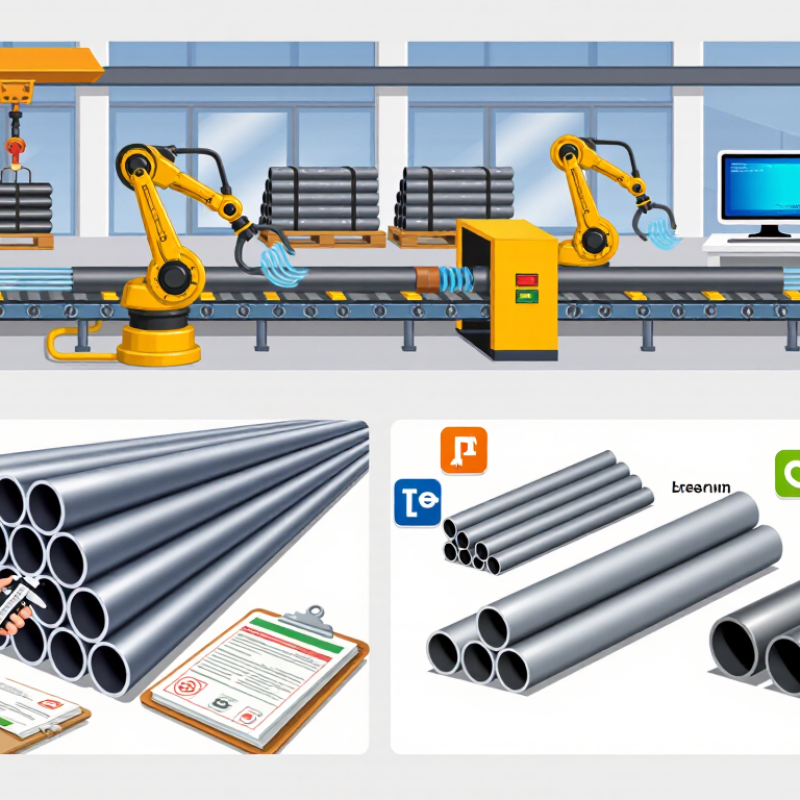
Welded pipes begin as flat steel strip or plate, not as hollow tubes. World Steel Association’s World Steel in Figures 2024 reports about 1,892 million tonnes of crude steel production in 2023. That enormous base supports water, construction, energy, and industrial pipe production. Yet steel volume alone does not prove pipe quality.
A mill uncoils the strip, trims its edges, and forms it around rollers. High-frequency electric resistance welding then joins the seam through heat and pressure. Larger diameters may use spiral or longitudinal submerged-arc welding. The pipe is sized, cut, and inspected. Common checks include ultrasonic testing, visual examination, dimensional measurement, and hydrostatic testing. ISO 3183 and API Specification 5L describe important requirements for line pipe materials, manufacturing, and testing.
The process sounds tidy. It is not always. Small edge misalignment can create a weak seam or uneven wall stress. Experienced inspectors therefore review weld records, heat numbers, calibration data, and non-destructive test results. A 2023 report from the International Energy Agency notes that steel remains central to energy infrastructure, increasing pressure for reliable and lower-emission production. Buyers should also examine coating systems, tolerance data, and traceability documents. A polished certificate is useful, but it should not replace independent verification.

Welded pipe selection starts with the service conditions, not the price list. For water, structural, or pressure applications, confirm that the pipe specification matches its intended use. Common references include ASTM A53 for general-purpose pipe, ASTM A500 for structural tubing, API 5L for line pipe, and EN 10217 for pressure purposes. These standards are not interchangeable. Check the applicable edition and grade with the project engineer.
Read the full specification. It should identify the steel grade, outside diameter, wall thickness, length, and permitted tolerances. For example, a small wall-thickness variation can affect fit-up and pressure calculations. Requirements may also cover seam type, heat treatment, and inspection. Depending on the standard and order, testing can include tensile tests, flattening tests, hydrostatic testing, or nondestructive examination. Ask for traceable inspection records and verify that markings match the supplied documents. Details matter.
Tips: Compare the purchase order with the mill test certificate before installation. Check dimensions at several points, especially near pipe ends. Confirm coating requirements separately; a base-pipe standard may not specify the finished coating. If a requirement is unclear, ask the supplier to explain it in writing. Paperwork helps, but it does not replace checking the actual pipe. Even a careful checklist can miss a detail, so review unusual service conditions with a qualified engineer.
How to Evaluate Chinese Welded Pipe Manufacturers
China’s welded-pipe sector serves construction, machinery, and energy projects, but a large market does not guarantee consistent quality. World Steel Association data put global crude steel production at 1.882 billion tonnes in 2024. That scale makes supplier verification essential. Ask for mill test certificates linked to the actual heat and production batch. Check whether dimensions, wall thickness, weld appearance, and surface condition match your purchase specification. Small details matter. A clean sample is useful, but it cannot prove routine production quality.
Review the manufacturer’s documented quality controls, inspection equipment, and traceability process. For line pipe, compare stated requirements with ISO 3183; for general steel pipe, confirm the applicable product specification, such as ASTM A53, where relevant. Request recent inspection records and clarify how nonconforming products are handled. An independent inspection before shipment can verify quantity, markings, and selected measurements. I would not rely on a certificate alone; paperwork can look complete while leaving practical questions unanswered.
Tips: Send the same technical checklist to each candidate. Include grade, outside diameter, wall thickness, length tolerance, coating, and test requirements. Ask for dated photos of marked bundles and packing. Check response quality, not just price. If answers are vague, pause and ask again. That extra step may feel tedious, but it can prevent costly rework.
Use this suggested 100-point evaluation framework when comparing welded pipe suppliers. Confirm product requirements against the applicable standard, such as ISO 3183, API 5L, ASTM A53, or ASTM A500.
The highest priorities are compliance, material traceability, weld integrity, and independent testing. A reliable evaluation should include mill test certificates, heat-number traceability, dimensional inspection records, hydrostatic or other required testing, and non-destructive examination reports where specified.
China’s welded pipe industry is concentrated in several manufacturing regions. Hebei is known for carbon steel, ERW, and large-diameter pipe production. Shandong offers broad capacity for structural, fluid, and industrial applications. Jiangsu and Zhejiang have stronger capabilities in stainless steel, precision welding, and customized fittings. Guangdong is notable for stainless decorative and process piping.
Production quality varies between factories. Some plants operate automated forming lines, multi-stage welding equipment, and real-time dimensional controls. Experienced suppliers can provide hydrostatic testing, ultrasonic inspection, chemical analysis, and traceable mill certificates. Buyers should verify wall thickness, outside diameter, welding method, and applicable standards before ordering. A polished website proves little.
Tips: Request recent inspection records and production videos. Confirm whether testing is performed in-house or by an independent laboratory. Ask for sample pipes before approving large quantities. Regional reputation helps, but it cannot replace a technical audit. Even capable factories may struggle with unusual alloys or strict tolerances, so specifications must be written clearly. That detail is often overlooked.
Regional overview of common welded-pipe production strengths. Capabilities vary by mill and product line; confirm dimensions, materials, standards, testing, and current capacity directly with each supplier.
| Major Supplier Region | Common Welded Pipe Products | Typical Production Capabilities | Common Materials | Typical Applications | Standards and Verification Points |
|---|---|---|---|---|---|
| Zhejiang, including Wenzhou and Jiaxing | Stainless-steel welded tubes and pipes; decorative, sanitary, and industrial tube products | Common processes include TIG welding and, for some product lines, high-frequency welding. Suppliers may offer polished, pickled, annealed, or cut-to-length finishes. | Common austenitic grades include 304 and 316/316L; grade availability depends on the producer. | Food and beverage equipment, architectural fittings, fluid handling, and general industrial use | Confirm the applicable ASTM, EN, or GB specification, grade, dimensions, surface finish, weld quality, and material test documentation. |
| Jiangsu, including Wuxi, Suzhou, and Changzhou | Stainless and carbon-steel welded tubes; precision and mechanical tubing | Production may include high-frequency welding for carbon-steel tube and TIG or other welding processes for stainless products. Finishing and dimensional tolerances vary by line. | Carbon steel and commonly used stainless grades such as 304 and 316L | Machinery, automotive components, furniture, construction, and industrial equipment | Check wall-thickness tolerance, outside-diameter tolerance, straightness, heat treatment requirements, and the standard specified in the purchase contract. |
| Shandong, including Liaocheng and Qingdao | Carbon-steel ERW pipe and tube; structural and fluid-service pipe | ERW lines are commonly used for longitudinal-seam pipe in a range of commercial sizes. Some suppliers provide cutting, end preparation, coating, and inspection services. | Common carbon-steel grades selected to the relevant product specification | Water and general fluid service, structural use, machinery, and infrastructure projects | Verify the required product standard, grade, hydrostatic or nondestructive testing, coating system, and traceability requirements. |
| Tianjin and nearby Hebei, including Cangzhou | ERW, SSAW (spiral submerged-arc welded), and large-diameter welded steel pipe | Regional production includes longitudinal ERW pipe and spiral-welded pipe; available diameter, wall thickness, and length ranges are mill-specific. Coating and pipe-end services may be available. | Carbon steel grades for line pipe, water transmission, and structural applications | Oil and gas transmission, water projects, piling, and civil infrastructure | Specify applicable standards such as API 5L or relevant GB/EN requirements. Confirm grade, dimensions, weld inspection, hydrotest, coating, and mill test certificates. |
| Hebei, including Cangzhou and surrounding industrial areas | Large-diameter SSAW and LSAW (longitudinal submerged-arc welded) pipe, alongside other welded pipe products | Some producers specialize in heavy-wall or large-diameter products for project orders. Actual size ranges and production routes differ by plant and equipment. | Carbon and low-alloy steels selected for the required strength and service conditions | Pipeline, water conveyance, structural piles, and energy infrastructure | Review design code and product standard, steel grade, seam inspection method, pressure testing, dimensional inspection, and project-specific qualification records. |
| Guangdong, including Foshan | Stainless-steel welded tube and pipe, including architectural and decorative products | Common product offerings include round, square, and rectangular sections, with polished or brushed finishes available from some suppliers. | Commonly offered stainless grades include 201, 304, and 316; suitability depends on the environment and specification. | Building decoration, handrails, furniture, equipment enclosures, and general fabrication | Confirm actual chemical composition and grade, finish, dimensional tolerances, corrosion requirements, and whether the product is intended for structural or pressure service. |
| Multiple manufacturing regions | Project-specific welded pipe, including coated or fabricated products | Capabilities may include beveling, threading, end forming, cut-to-length, external or internal coating, and third-party inspection, depending on the supplier. | Material selection depends on the product standard, operating conditions, and customer specification. | Construction, utilities, process plants, energy, and OEM supply chains | Request a current capability list, approved drawings, inspection and test plan, sample certificates, production lead time, and confirmation of export documentation. |
China Best Welded Pipe Manufacturers and Suppliers?
“Best” should mean measurable performance, not a low quotation. Ask for heat numbers, mill certificates, welding procedures, and recent inspection records. Check outside diameter, wall thickness, ovality, weld appearance, and hydrostatic results against the contract standard. ISO 9001 supports process control, but it does not prove every batch is compliant. The World Steel Association reported 1.892 billion tonnes of crude steel production in 2023. That scale creates options, but also makes traceability essential. Paperwork matters.
Pricing should separate steel, forming, welding, testing, packing, inland transport, and ocean freight. The World Bank Pink Sheet shows steel prices can shift sharply across reporting months. Request a validity period, currency, Incoterm, coating specification, and surcharge formula. A cheaper offer may hide thinner walls, weaker packaging, or excluded inspection. Those savings can disappear at the port. One honest weakness remains: forecasts rarely capture sudden energy or freight shocks.
For export orders, compare HS code classification, origin documents, certificates, and destination testing rules. UN Comtrade’s HS 7306 series helps compare declared tube trade values and quantities. Use it carefully; the code covers several tube categories, not one product alone. UNCTAD reported 12.3 billion tonnes of seaborne trade in 2022, underlining the importance of cargo planning. Confirm bundle length, lifting points, moisture protection, marking, and container limits before production. Small errors compound. Photographic records and independent pre-shipment inspection improve reliability, although neither replaces a sound contract.
Same Day Shipping
ISO Certified Production