Double Head Bolts are small components with demanding jobs. They anchor flanges, machinery, and structural assemblies where one threaded end enters a base and the other secures a part. Buyers often compare thread accuracy, steel grade, heat treatment, coating, and dimensional consistency. A clean thread matters. So does the inspection record behind it.
The market context is significant, but it needs careful interpretation. Grand View Research estimated the global fasteners market at USD 90.6 billion in 2023 and projected a 4.5% compound annual growth rate from 2024 to 2030. That figure covers many fastener types, not Double Head Bolts alone. It signals broad industrial demand, rather than proving the scale of this specific product category. For technical screening, ISO 898-1 provides mechanical-property requirements for carbon and alloy steel bolts, screws, and studs within its scope. Buyers should still confirm that a supplier’s test documents match the ordered material, dimensions, and intended application. A certificate is useful. Traceability matters more when a batch is rejected or a fit is wrong.
This overview of China’s top ten manufacturers considers product range, production capability, quality controls, and export experience. These factors help narrow a supplier shortlist, but a ranking cannot replace factory verification or sample testing. Catalogs can look polished. Real performance is less tidy. The right manufacturer is the one that can consistently deliver the required thread, strength, finish, and documentation—and explain what happens when it cannot.
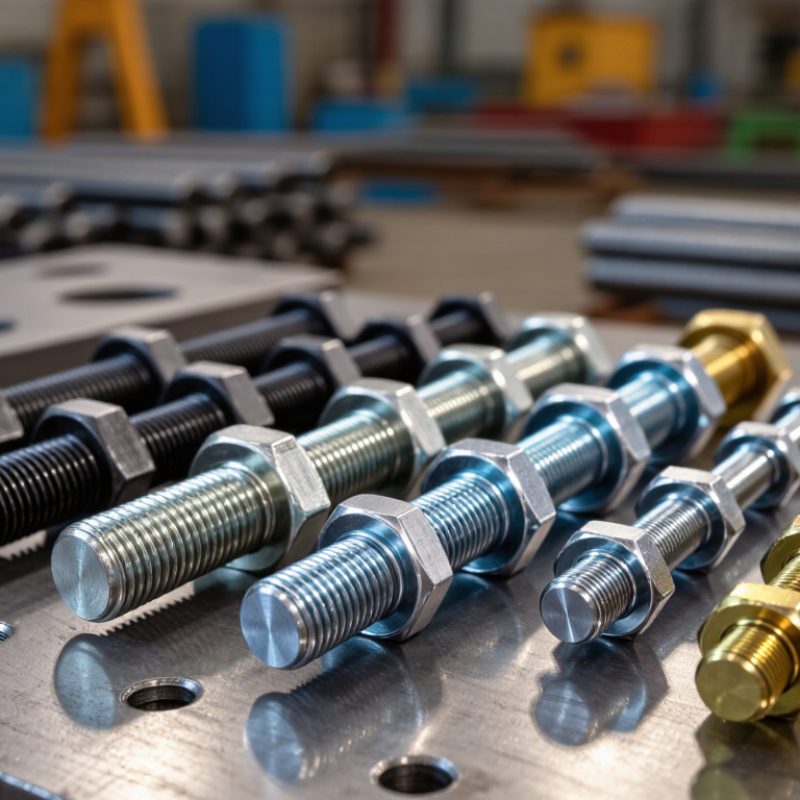
A double head bolt, often called a double-ended stud, has threaded ends rather than a conventional bolt head. One end may seat in a tapped hole or remain fixed in an assembly; a nut secures the other end. Some designs include a smooth central shank. That section helps locate parts, but its dimensions must match the joint. In practice, the name is not always used consistently. Check the drawing, thread lengths, and material specification before ordering.
Unlike a headed bolt, a stud can leave its nut-side threads accessible when the joint is assembled. A screw usually drives directly into a threaded hole, while a stud typically works with a separate nut. The distinction matters during maintenance: a damaged stud can sometimes be replaced without turning a bolt head inside a crowded space. ISO 898-1 classifies mechanical properties of carbon and alloy steel fasteners; class 8.8 denotes a nominal tensile-strength level of 800 MPa. Actual requirements depend on product dimensions and the applicable specification. The wider market shows the scale of this hardware category: Grand View Research valued the global industrial fasteners market at about USD 90.4 billion in 2023. That figure covers many fastener types, not double head bolts alone. A useful reminder. A matching strength class does not, by itself, guarantee a suitable joint.

A double-ended stud—sometimes informally called a double head bolt—has two threaded ends and no head. A typical hex bolt and machine screw each have one threaded end and one head. These counts describe basic features, not strength or performance.
Double head bolts, often called double-end studs, have threads at both ends and a plain shank between them. Material choice depends on load, temperature, corrosion exposure, and the mating components. Carbon steel is common for general machinery and structural connections. Alloy steel can provide higher strength after controlled heat treatment. Stainless steel is useful in damp or corrosive settings, though its strength and galling behavior need careful consideration. Details matter.
Specifications Specifications should state nominal diameter, overall length, thread length at each end, pitch, and tolerance. Metric and inch threads are not interchangeable. Drawings should also identify the required material grade and mechanical properties, rather than relying on a vague label such as “high strength.” Standards such as ASTM A193 cover particular stud materials and service conditions; the correct specification depends on the application. Check the nut and tapped-hole requirements too.
Manufacturing & Inspection Manufacturers may cut blanks from bar stock, form the ends, and roll threads before or after heat treatment, depending on size and process controls. Thread rolling can produce consistent profiles, while machining may suit unusual dimensions or small batches. Coatings such as zinc plating can affect fit, so finished dimensions deserve inspection. A practical incoming check includes thread gauges, length measurement, and material records. I would not treat appearance alone as proof; even a clean-looking batch can hide a pitch mismatch. Production details vary, and that is worth confirming.
Double head bolts are used when a joint needs secure clamping and straightforward disassembly. Common examples include engine cylinder heads, pump casings, pressure-vessel covers, pipe flanges, and wind-turbine sections. One end threads into a tapped component; the exposed end accepts a nut. This arrangement can reduce wear on internal threads during maintenance. Small parts. High consequences.
In piping systems, temperature changes, vibration, and flange loading make correct stud length, thread engagement, material, and tightening procedure important. Follow the equipment design specifications rather than relying on torque by feel. The Global Wind Energy Council’s Global Wind Report 2025 recorded 117 GW of new wind installations in 2024, bringing cumulative capacity to 1,136 GW. That growth means more bolted joints in towers, nacelles, and service work. The IEA’s Renewables 2024 report projects nearly 5,500 GW of new renewable power capacity by 2030, adding further installation and maintenance demands. These figures describe sector growth, not bolt consumption. In practice, corrosion protection and thread condition matter as much as headline strength. It is easy to overfocus on grade; field fit-up deserves equal attention.
China Top 10 Double Head Bolt Manufacturers
How to Assess Double Head Bolt Manufacturers in China
A reliable assessment starts with drawing control, not a polished catalog. Ask for dimensional inspection records covering thread pitch, overall length, runout, and concentricity. For each lot, request material certificates linked to heat numbers and mechanical-test results. Small checks matter. ISO 898-1 specifies mechanical-property classes for carbon and alloy steel fasteners; confirm the quoted grade and test method match your drawing.
Production scale alone is weak evidence. The World Steel Association reports that China produced 1,019.1 million tonnes of crude steel in 2023, but national output does not verify a supplier’s material source or consistency. Grand View Research estimated the global industrial fasteners market at USD 90.5 billion in 2023, with projected annual growth of 4.4% through 2030. Samples reveal gaps. Traceability and process control tell you more than capacity claims.
During a factory review, inspect thread rolling, heat-treatment monitoring, coating checks, and rejected-part segregation. Compare a pre-production sample with production pieces using calibrated gauges. Ask how nonconformities are recorded and corrected, not just whether the supplier holds a quality certificate. Certificates help, but they cannot replace factory checks. I would also verify lead-time records and subcontracted processes. A neat audit file can still miss a weak handoff between heat treatment and final inspection.
A 10-criterion framework for comparing suppliers. The weights below are suggested evaluation weights, not published rankings or verified scores for specific manufacturers.
| Assessment criterion | Suggested weight | What to verify | Useful evidence or reference |
|---|---|---|---|
| 1. Product and application fit | 12% | Confirm the supplier can make the required double-end studs, including specified end lengths, unthreaded shank, diameter, overall length, and application. | Dimensioned drawings, product specifications, and sample parts approved against the purchase drawing. |
| 2. Material and grade control | 14% | Check that material, grade, and heat-treatment requirements match the order and intended service conditions. | Material test certificates with traceable heat or batch numbers. For applicable products, confirm the specified standard and grade, such as ISO 898-1 property classes or ASTM A193 grades. |
| 3. Thread accuracy and fit | 12% | Verify thread diameter, pitch, tolerance class, thread length, and compatibility with the mating nuts or tapped holes. | Thread gauges and inspection records; specify the applicable thread system and tolerances, such as ISO metric threads with tolerances selected under ISO 965. |
| 4. Mechanical testing | 12% | Establish which mechanical properties are required and confirm testing is appropriate for the ordered material and product standard. | Batch-linked test reports for applicable properties, such as tensile strength, yield or proof strength, hardness, and elongation when required by the governing specification. |
| 5. Heat treatment and process control | 10% | For grades requiring heat treatment, review process controls, batch identification, and controls against mix-ups or nonconforming output. | Process records, heat-treatment charts where applicable, calibration records, and documented lot traceability. |
| 6. Coating and corrosion requirements | 10% | Specify coating type, thickness or performance requirement, and any restrictions related to the material or application. Do not assume one coating suits every environment. | Coating specification and inspection results. Relevant references may include ISO 4042 for electroplated coatings or ISO 10683 for non-electrolytically applied zinc-flake coatings, where applicable. |
| 7. Inspection and quality system | 10% | Assess incoming-material checks, in-process inspection, final inspection, nonconformance handling, and corrective-action procedures. | Quality manual or process overview, inspection plans, sample inspection reports, and a current ISO 9001 certificate if claimed. Verify certificate scope and validity with the issuing body. |
| 8. Traceability and documentation | 8% | Confirm that finished goods can be linked to production lots and the material and inspection records required by the order. | Consistent lot markings, packing-list references, certificates, and a documented method for retrieving records. |
| 9. Production capacity and delivery planning | 6% | Compare quoted lead time, order quantity, production scheduling, and the supplier’s plan for managing delays or urgent requirements. | A written production schedule, capacity statement tied to the requested order, and shipment records for comparable orders where available. |
| 10. Commercial clarity and communication | 6% | Review quotation completeness, Incoterms, packaging, payment terms, change control, response time, and the process for handling claims. | Written quotation, approved drawings and specifications, agreed inspection and acceptance terms, and a named point of contact. |
| Total suggested evaluation weight | 100% | Score each criterion against the same evidence requirements for every supplier; confirm all applicable standards and acceptance criteria in the purchase specification. | |
China’s double head bolt sector includes factories with different strengths. One producer focuses on standard threaded studs for machinery maintenance. Another offers custom lengths, useful when drawings specify unusual dimensions. A third emphasizes alloy-steel options for equipment exposed to repeated loads. Details matter.
A fourth manufacturer supports small-batch orders, while a fifth is set up for larger production runs. A sixth provides machining for shoulder and thread transitions. A seventh serves construction suppliers with common stud sizes. An eighth highlights inspection records and dimensional checks. A ninth handles made-to-order materials, though buyers should confirm certificates directly. A tenth combines manufacturing with export packing for long-distance shipments.
These profiles describe capabilities to investigate, not a ranking. Ask each supplier about thread tolerances, material traceability, surface treatment, and inspection methods. Request a sample when fit is critical. Check the thread with a gauge and compare the bolt’s length against the drawing. Some catalogs look complete, yet stock can change. That is easy to overlook. Clear specifications and written acceptance criteria help buyers compare manufacturers on practical terms.
Same Day Shipping
ISO Certified Production